The Most Beautiful (but Creepy) Cemeteries in the World
There are few places that inspire as much fascination—and as much hesitation—as cemeteries. For many, they are solemn spaces reserved for grief and remembrance. For others, they are open-air museums, historical archives, botanical gardens, architectural masterpieces, and surprisingly peaceful retreats. Yet there is another quality that makes certain cemeteries irresistible: they are undeniably creepy.
But why?
Perhaps it’s the silence. Perhaps it’s the centuries-old statues staring blankly into eternity. Or perhaps it’s the unsettling realisation that every weathered headstone represents a life once as vibrant as our own.
The world’s most beautiful cemeteries occupy a curious space between art and archaeology, memory and mystery. They invite us to admire exquisite sculptures while reminding us that beauty itself is fleeting. Like a well-written novel, they simultaneously comfort and unsettle us.
This article explores ten extraordinary cemeteries where breathtaking artistry meets haunting atmosphere. Some are famous for Gothic architecture. Others conceal legends of ghosts, vampires, or forgotten tragedies. Together, they demonstrate that cemeteries are far more than resting places—they are cultural landscapes that reveal how societies understand death, memory, religion, and identity.
So, shall we take a walk among the dead?
The Most Beautiful (but Creepy) Cemeteries in the World
1. Père Lachaise Cemetery (Paris, France)
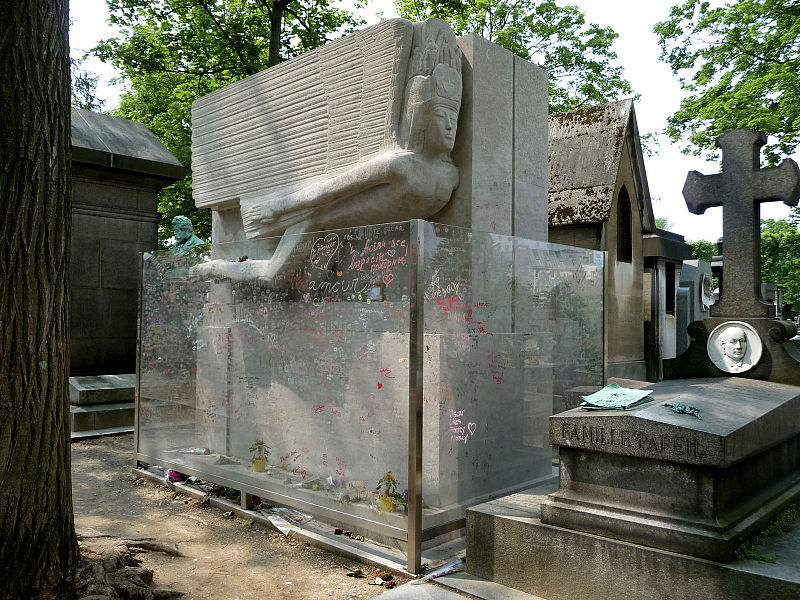
Few cemeteries have achieved the legendary status of Père Lachaise. Covering more than 110 acres, it resembles a miniature city complete with winding avenues, elaborate mausoleums, hidden courtyards, and thousands of permanent residents who, thankfully, no longer complain about the neighbours.
Opened in 1804, Père Lachaise was initially unpopular because it lay outside Paris. City officials cleverly solved the problem by relocating the remains of famous figures such as Molière and La Fontaine, transforming the cemetery into the most fashionable address in death.
Today, visitors flock to see the graves of Oscar Wilde, Jim Morrison, Édith Piaf, Frédéric Chopin, Marcel Proust, and hundreds of other notable figures.
Yet celebrity is only part of its appeal.
Architecturally, Père Lachaise is astonishing. Neo-Gothic chapels stand beside Classical mausoleums, Art Nouveau sculptures emerge from ivy-covered tombs, and angels weathered by two centuries of rain appear almost alive.
The cemetery’s beauty is inseparable from its atmosphere. Mist clings to ancient stone during autumn mornings, while quiet pathways twist unexpectedly between towering monuments. Every corner feels like another chapter waiting to be read.
It is difficult to imagine a better example of death transformed into art.

2. Highgate Cemetery (London, England)
If Gothic literature needed a physical location, it would probably choose Highgate Cemetery.
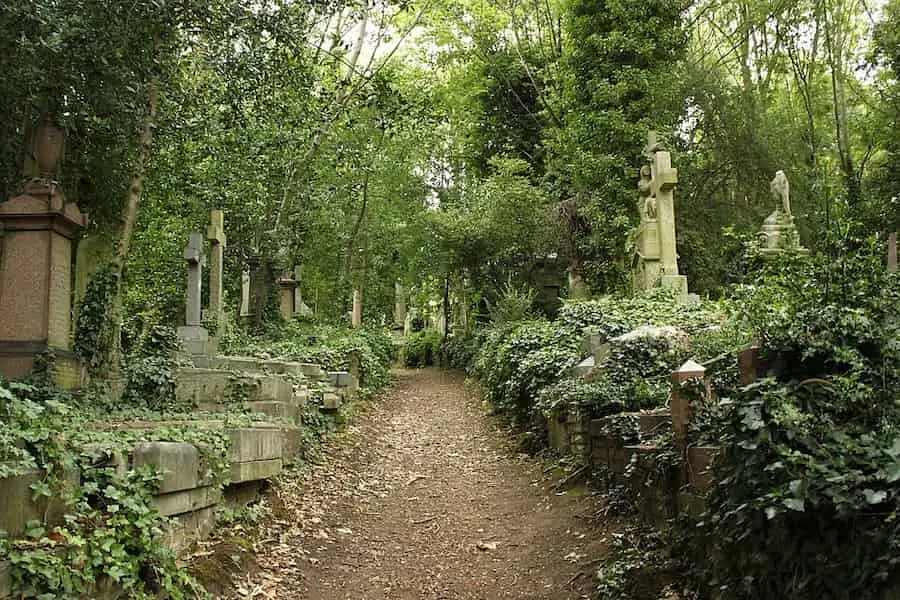
Established in 1839 during London’s Victorian cemetery movement, Highgate quickly became one of Britain’s most architecturally ambitious burial grounds.
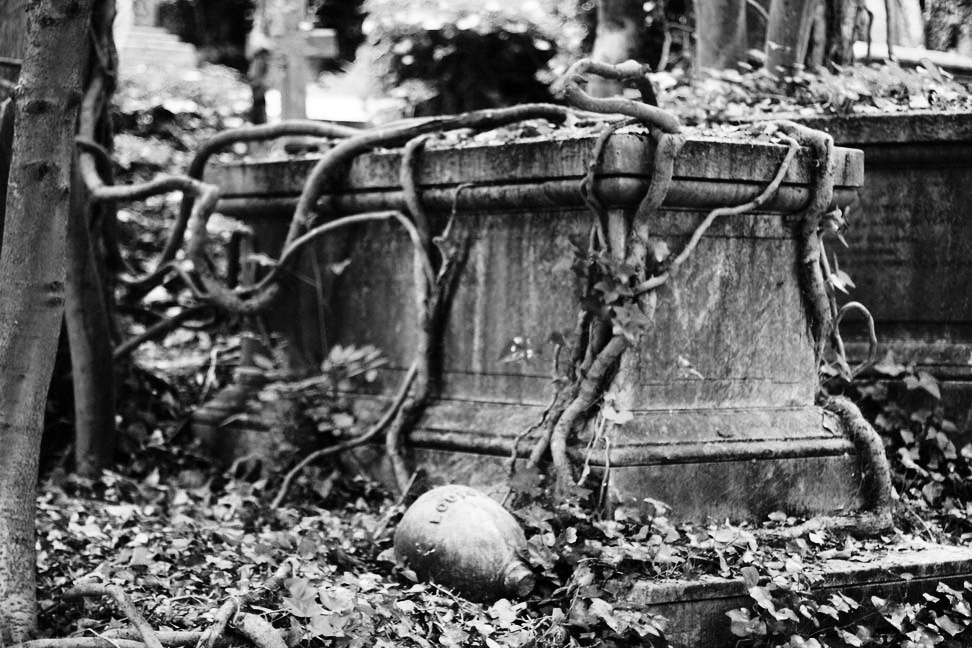
Nature has since reclaimed much of it.
Massive tree roots embrace tombs. Ivy swallows angels whole. Moss softens marble into something almost organic. Rather than fighting decay, Highgate seems to collaborate with it.
The famous Egyptian Avenue and Circle of Lebanon exemplify Victorian fascination with ancient civilizations and exotic symbolism. Massive stone passages descend into elaborate family vaults, creating scenes that feel closer to an archaeological expedition than a cemetery visit.
Of course, Highgate is equally famous for its legends.
The so-called “Highgate Vampire” panic of the 1970s transformed the cemetery into the centre of one of Britain’s strangest supernatural stories. While historians dismiss the tale as urban folklore, it continues to attract paranormal enthusiasts.
Whether or not vampires ever wandered Highgate, one thing is certain: few cemeteries blur the line between history and Gothic imagination so successfully.
3. Recoleta Cemetery (Buenos Aires, Argentina)
At first glance, Recoleta hardly resembles a cemetery at all.
Instead, it resembles a luxurious marble city where every building happens to be a tomb.
Unlike traditional graveyards, Recoleta consists almost entirely of elaborate family mausoleums lining narrow streets. Walking through its avenues feels remarkably similar to wandering an elegant European neighbourhood—only much quieter.
The cemetery reflects Argentina’s aristocratic past. Wealthy families competed to construct increasingly elaborate mausoleums featuring French, Italian, Art Deco, Egyptian Revival, and Neoclassical influences.
Some resemble miniature cathedrals.
Others resemble private palaces.
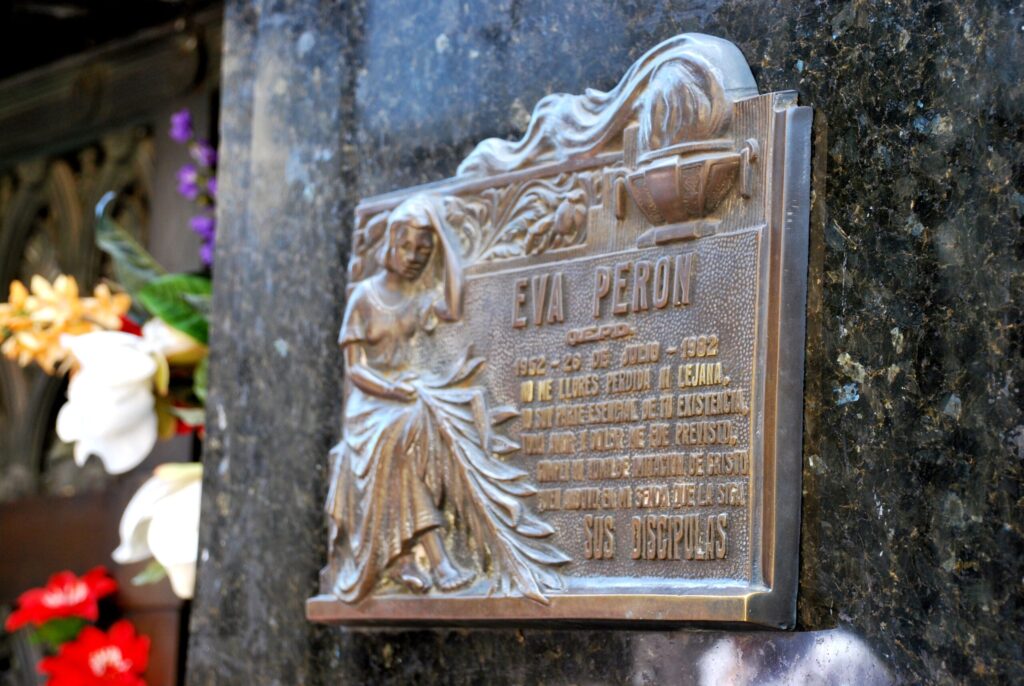
Among its most visited graves is that of Eva Perón, whose modest family vault contrasts sharply with many surrounding monuments.
Yet beneath the beauty lies an unmistakable eeriness.
Many mausoleums have glass windows revealing ageing coffins, faded photographs, and religious objects gathering dust. Time appears suspended.
It is less frightening than profoundly melancholic—a reminder that even the grandest architecture cannot escape entropy.

4. Staglieno Monumental Cemetery (Genoa, Italy)
If sculpture could mourn, it would probably look like Staglieno.
Often considered the world’s greatest cemetery for funerary sculpture, Staglieno contains hundreds of breathtaking marble masterpieces.
Victorian travellers described it as an open-air art gallery.
They were not exaggerating.
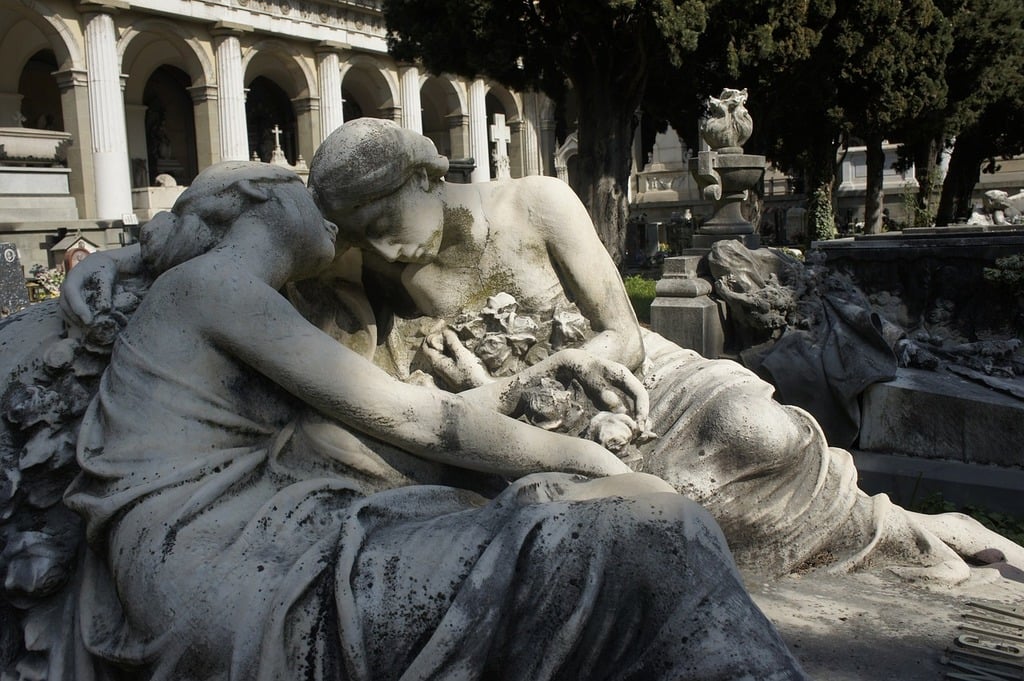
Angels appear frozen mid-flight. Widows collapse in grief with astonishing realism. Drapery carved from marble seems softer than fabric itself.
The level of craftsmanship is extraordinary.
Many sculptures intentionally blur the boundary between life and death. Rather than depicting idealised saints, they portray ordinary people experiencing profound emotion.
Walking through Staglieno is emotionally exhausting—in the best possible way.
Every monument tells a story.
Every face seems capable of speaking.
And every sculpture reminds us that grief itself has inspired some of humanity’s finest artistic achievements.

5. Okunoin Cemetery (Mount Kōya, Japan)
Not every creepy cemetery relies on Gothic architecture.
Some rely on silence.
Hidden beneath towering cedar forests on Mount Kōya, Okunoin contains more than 200,000 graves stretching along peaceful woodland paths.
Unlike many Western cemeteries, its atmosphere is deeply spiritual rather than overtly mournful.
Moss-covered gravestones disappear beneath ancient trees.
Stone lanterns glow softly along shaded pathways.
Morning fog transforms the forest into something almost dreamlike.
According to Buddhist tradition, the revered monk Kūkai did not truly die but entered eternal meditation, awaiting the future Buddha. Many believers therefore choose burial near him, hoping to share in his spiritual presence.
The result is one of the world’s most tranquil—and quietly haunting—cemeteries.
Nothing jumps out to frighten visitors.
Instead, the forest whispers.
The silence itself becomes part of the experience.
It is a place that invites reflection rather than fear, proving that the creepiest places are not always the loudest.


6. The Old Jewish Cemetery (Prague, Czech Republic)
Few cemeteries in the world evoke the passage of time as powerfully as the Old Jewish Cemetery in Prague.
At first glance, it appears almost impossible. Thousands of crooked gravestones lean precariously against one another like a crowd frozen in motion. Some stones have sunk into the earth. Others overlap at impossible angles. Together, they create one of the most haunting landscapes in Europe.
Founded in the early fifteenth century, the cemetery served Prague’s Jewish community for more than 300 years. Because Jewish law traditionally discourages relocating graves and the cemetery could not be expanded beyond the confines of the Jewish Quarter, generations of burials accumulated in the same limited space. Rather than removing older graves, new layers of soil were added above them. Historians estimate that there may be as many as 100,000 people buried here beneath approximately 12,000 visible headstones.
The result is visually extraordinary.
Unlike the symmetrical order found in many modern cemeteries, the Old Jewish Cemetery embraces imperfection. The uneven stones resemble pages of a history book that have been gently folded by time.
It is impossible to walk these narrow paths without reflecting on the resilience of Prague’s Jewish community, whose history encompasses flourishing scholarship, persecution, survival, and remembrance.
The cemetery’s eerie beauty lies not in ghost stories but in historical weight. Every leaning gravestone represents not merely an individual life but centuries of cultural endurance.
Sometimes history is more haunting than mythology.


7. Greyfriars Kirkyard (Edinburgh, Scotland)
If cemeteries could win awards for atmosphere, Greyfriars Kirkyard would surely be among the finalists.
Situated in the heart of Edinburgh’s Old Town, this seventeenth-century burial ground effortlessly combines history, Gothic architecture, folklore, and literary inspiration.
Its weather helps.
Low-hanging mist, rain-darkened stone, and centuries-old monuments create a setting that feels tailor-made for ghost stories.
Greyfriars is perhaps best known for two entirely different legends.
The first is heartwarming: the story of Greyfriars Bobby, the loyal Skye Terrier said to have guarded his owner’s grave for fourteen years. His statue nearby has become one of Edinburgh’s most beloved landmarks.
The second is considerably darker.
The infamous “Mackenzie Poltergeist” allegedly haunts the mausoleum of Sir George Mackenzie, a seventeenth-century lawyer associated with the persecution of Scottish Covenanters. Paranormal investigators claim visitors have experienced scratches, fainting spells, and unexplained phenomena.
Whether one believes these accounts is beside the point.
What makes Greyfriars remarkable is its ability to blur the boundaries between documented history and local folklore. Here, stories are almost as carefully preserved as the graves themselves.
Interestingly, many scholars also note similarities between names found in Greyfriars and characters that later appeared in fantasy literature, demonstrating how cemeteries often inspire the imagination as much as they preserve the past.


8. Merry Cemetery (Săpânța, Romania)
Can a cemetery be cheerful?
At first glance, the question seems almost absurd.
Then you arrive in the Romanian village of Săpânța.
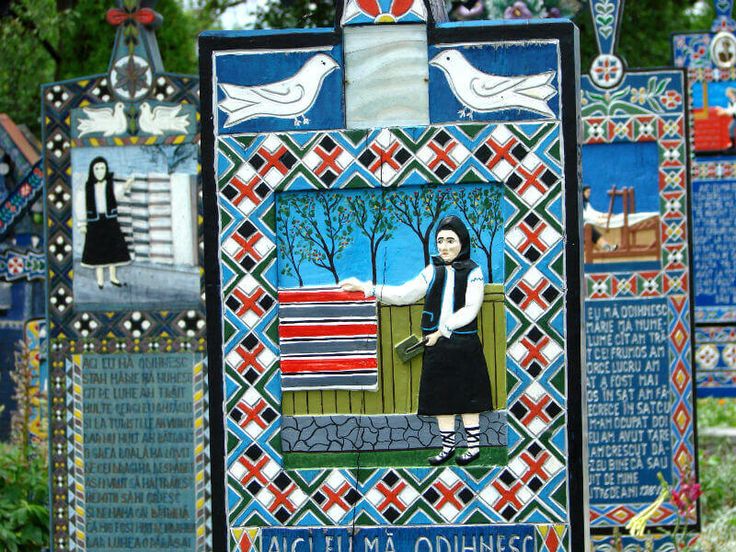
Unlike virtually every other cemetery on this list, the Merry Cemetery rejects the sombre aesthetic traditionally associated with death. Instead of black marble and solemn angels, visitors encounter vividly painted blue wooden crosses decorated with colourful folk art and often surprisingly humorous epitaphs.
Rather than portraying death as something frightening, these memorials celebrate personality.
One inscription jokes about a lifelong love of wine.
Another gently teases the deceased’s habits.
Others recount ordinary moments with honesty and affection.
The tradition began in the 1930s under the guidance of local woodcarver Stan Ioan Pătraș, who believed death should be remembered with sincerity rather than overwhelming sadness.
The result is surprisingly moving.
Far from diminishing respect for the deceased, humour humanises them. It reminds us that people are remembered not only for how they died but for how they lived.
The Merry Cemetery challenges one of our deepest assumptions: that remembrance must always be solemn.
Sometimes a smile is as meaningful as a tear.

9. San Michele Cemetery (Venice, Italy)
Surrounded entirely by water, San Michele appears almost mythical.
Located on its own island between Venice and Murano, the cemetery serves as the city’s principal burial ground—a necessity in a lagoon where land is precious.
Approaching by boat only heightens its atmosphere.
Stone walls rise from the water.
Tall cypress trees conceal elegant cloisters.
Church bells echo across the lagoon.
Unlike many sprawling cemeteries, San Michele possesses remarkable order. Monastic architecture, Renaissance influences, and carefully maintained gardens create an atmosphere of quiet contemplation.
Yet beneath this serenity lies an important reminder of Venice’s unique relationship with mortality.
For centuries, burials within the city posed public health challenges. Establishing an island cemetery represented both practical urban planning and evolving attitudes toward sanitation.
Today, visitors come not only for its beauty but also to pay respects to notable figures buried there, including composer Igor Stravinsky and poet Ezra Pound.
San Michele demonstrates that even practical solutions can become places of extraordinary aesthetic value.
Death, after all, often shapes cities as much as life does.


10. The Catacombs of Paris (An Honorable Inclusion)
Strictly speaking, the Catacombs are not a cemetery.
Yet excluding them from any discussion of beautiful and unsettling burial spaces would feel almost criminal.
Beneath the bustling streets of Paris lies an underground labyrinth containing the carefully arranged skeletal remains of more than six million people.
Originally limestone quarries, the tunnels were transformed into an ossuary in the late eighteenth century after overcrowded cemeteries created serious public health concerns.
What makes the Catacombs extraordinary is their unexpected artistry.
Bones are not piled randomly.
Skulls and femurs are arranged into symmetrical patterns, crosses, columns, and decorative walls. It is macabre architecture—equal parts practical engineering and philosophical statement.
Visitors often describe conflicting emotions.
There is awe.
There is discomfort.
There is curiosity.
Above all, there is humility.
The famous inscription near the entrance reads: “Stop! This is the Empire of Death.”
Few places communicate humanity’s shared mortality more directly.


Why Are We Drawn to Creepy Cemeteries?
It may seem contradictory that millions of people voluntarily visit places associated with death.
Yet perhaps the contradiction exists only on the surface.
Cemeteries satisfy several deeply human curiosities.
They allow us to explore history through individual lives rather than abstract dates. They preserve remarkable architecture that might otherwise disappear. They function as outdoor sculpture galleries, botanical sanctuaries, and repositories of cultural identity.
Psychologists also suggest that encounters with mortality encourage reflection on our own lives. Rather than promoting despair, they often inspire gratitude and perspective.
In that sense, cemeteries are less about death than about life.
Every weathered inscription tells us someone laughed, loved, struggled, succeeded, failed, and hoped—just as we do.
That realisation is both unsettling and strangely comforting.
Bottom Line
The world’s most beautiful cemeteries remind us that death has never been merely a biological event. It is also a cultural expression, an artistic endeavour, and a historical record.
Whether wandering beneath the towering trees of Okunoin, admiring the marble masterpieces of Staglieno, navigating the labyrinthine streets of Recoleta, or standing among the leaning gravestones of Prague’s Old Jewish Cemetery, visitors encounter far more than graves. They encounter civilisations telling stories about memory, identity, faith, and the passage of time.
Perhaps that is why these places feel simultaneously beautiful and creepy. Beauty invites us closer, while mortality gently reminds us that we, too, are temporary visitors.
Far from being cities of silence, cemeteries speak volumes. We simply have to slow down long enough to listen.
Leave a Reply