Cremation Ashes and the Environment: Myths and Facts
Death may be inevitable, but what happens to us afterward has become surprisingly complicated.
For much of human history, burial practices were dictated by religion, geography, and tradition. Today, however, another consideration has entered the conversation: environmental impact. People increasingly wonder whether their final arrangements will leave behind more than memories. Cremation is often presented as a simpler alternative to conventional burial, but even cremation raises ecological questions—particularly when it comes to what happens to the ashes afterward.
Can cremation ashes harm plants? Do they enrich the soil? Is scattering ashes in the sea environmentally harmless? Are cremated remains basically the same thing as fireplace ash?
The short answer to that last question is no. The longer answer is considerably more interesting.
Cremation ashes occupy a peculiar space between human remains, mineral material, memorial object, and potential environmental contaminant. Around them has grown an impressive collection of assumptions, some scientifically plausible and others belonging firmly in the category of things that sound right because somebody on the internet said them confidently.
So, let’s separate the myths from the facts.
What Are Cremation Ashes Actually Made Of?
Before discussing the environmental impact of cremation ashes, we need to establish what they actually are.
Despite the familiar term “ashes,” cremated human remains are not primarily ash in the everyday sense. When a body undergoes cremation, organic tissues are consumed by intense heat. What remains is largely calcified skeletal material.
After cremation, these bone fragments are mechanically processed into the granular material families receive as cremated remains, often called cremains.
Chemically, they consist largely of mineral compounds derived from bone, particularly calcium phosphates, alongside other minerals and salts. Their precise composition can vary according to the individual and cremation process.
This matters because cremation ashes behave very differently from the soft grey residue left behind after burning wood.
Scatter wood ash around certain plants and, in appropriate quantities, it may serve as a soil amendment. Scatter concentrated human cremation ashes over a flower bed and you may get a rather less poetic result.
Myth 1: Cremation Ashes Are Good Fertiliser
Perhaps the most persistent environmental myth surrounding cremated remains is also the most understandable.
We associate death with decomposition and decomposition with fertility. A body returns to the earth, nutrients enter the soil, and new life emerges. It is one of nature’s oldest recycling systems.
Surely cremation ashes accomplish something similar?
Not quite.
Cremated remains contain minerals, including calcium and phosphorus, but simply containing nutrients does not make something an effective fertiliser. Plants require nutrients in appropriate chemical forms, concentrations, and proportions.
More importantly, cremation ashes can have a high pH and contain significant amounts of soluble salts. Concentrated salts interfere with plants’ ability to absorb water through their roots. Instead of nourishing vegetation, a large quantity of cremated remains deposited directly around a plant may stress or damage it.
Think of it like seasoning food. Salt is useful. An entire saltshaker dumped onto your dinner is considerably less useful.
The same principle applies here: concentration matters.
Fact: Cremation Ashes Can Affect Soil Chemistry
Once cremated remains enter soil, they interact with its existing chemical composition.
One important factor is alkalinity. Cremated remains are generally alkaline, meaning they can raise the pH of the immediate surrounding soil. Whether that creates a significant environmental problem depends on several variables: the quantity of ashes, the characteristics of the soil, rainfall, drainage, vegetation, and the size of the area over which they are distributed.
A handful dispersed across a broad landscape is very different from several kilograms concentrated around the roots of one tree.
This is why environmental discussions about cremation ashes should avoid dramatic absolutes. The question is rarely “Are ashes toxic?” in isolation. A better question is: What happens when this quantity of cremated remains is introduced into this particular environment?
Ecology, annoyingly for anyone seeking simple answers, loves context.
Myth 2: You Can Simply Bury Ashes Under a Memorial Tree
The image is irresistible: a beloved person’s ashes placed beneath a young tree, their remains literally becoming part of something that continues to grow.
Symbolically, it is beautiful.
Horticulturally, it needs a little more thought.
Placing a large quantity of untreated cremated remains directly into the planting hole can create unfavorable conditions for developing roots because of the alkalinity and salt concentration discussed above.
This does not mean memorial trees and cremation ashes are incompatible. It means the process needs to be designed intelligently.
Ashes may be incorporated into specially formulated soil mixtures or used with products designed to modify the chemical conditions around cremated remains. Alternatively, families can place ashes within a broader memorial landscape rather than concentrating them directly against the root system.
There is an important philosophical distinction here. A tree does not need to literally “feed” on someone’s ashes for it to serve as their memorial.
Symbolism can survive horticultural competence.
Fact: Scattering Is Different From Concentrated Burial
The environmental effects of cremated remains depend heavily on how they are deposited.
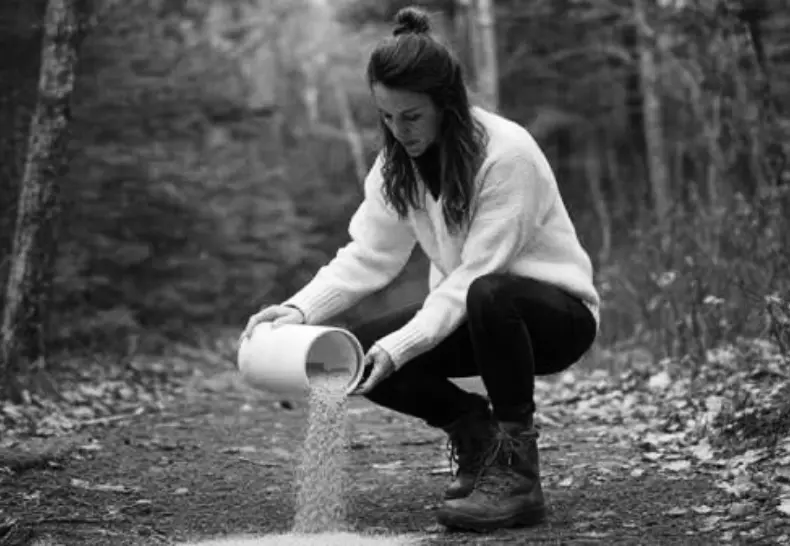
When ashes are scattered thinly across a large area, their minerals and salts are diluted. Rainfall, soil processes, and the size of the landscape further reduce local concentrations.
When the same amount is buried in one compact location, however, the environmental conditions are very different.
This distinction is especially important in popular scattering locations. One family scattering ashes over a large hillside may have negligible consequences. Hundreds or thousands of people repeatedly choosing precisely the same picturesque spot could create a cumulative effect.
And therein lies one of the central problems of environmental management: individually insignificant actions can become collectively significant.
The planet has seen this trick before.
Myth 3: Human Ashes Are Dangerous to Touch
Cremated remains sometimes acquire an aura of chemical menace simply because people are unfamiliar with them.
Under normal circumstances, cremated human remains are not biologically hazardous in the way an uncremated body potentially can be. The temperatures involved in cremation destroy microorganisms and organic tissue.
Handling cremated remains therefore does not ordinarily pose a biological danger.
That said, they consist of very fine particulate material. As with other fine powders, deliberately breathing the dust is hardly an excellent recreational activity. Basic common sense applies.
The more important environmental concerns relate to where ashes are deposited and in what quantities rather than casual physical contact with them.
Myth 4: Scattering Ashes in the Ocean Is Always Environmentally Harmless
There is something deeply appealing about scattering ashes into the sea. Oceans already carry enormous symbolic associations with eternity, movement, disappearance, and return.
From an environmental perspective, scattering cremated remains into a large body of water generally creates substantial dilution. This makes it fundamentally different from depositing them in a small pond or sensitive freshwater ecosystem.
But “the sea is enormous” should not become an excuse for ignoring everything else.
The environmental footprint of a sea memorial may include more than the ashes themselves. Urns, plastic decorations, artificial flowers, ribbons, wreaths, and other objects can become litter if released into the water. A biodegradable memorial and a floating arrangement containing synthetic materials are not environmentally equivalent.
There are also legal considerations. Rules governing the scattering of human remains vary by country and jurisdiction, and protected marine environments may have additional restrictions.
The environmentally sensible principle is straightforward: scatter the remains where permitted, but do not assume everything accompanying them belongs in the ecosystem.
The fish have little use for your polyester ribbon.
Fact: Location Matters
A rocky coastline, urban park, alpine meadow, forest, private garden, and protected wetland are not interchangeable environments.
Some ecosystems are much more sensitive to chemical disturbance or human activity than others. Protected landscapes may also contain rare plants, fragile soils, archaeological remains, or habitats vulnerable to trampling.
This means responsible ash scattering requires more than choosing somewhere beautiful.
Families should consider land ownership, local regulations, ecological sensitivity, accessibility, and whether the site already receives significant numbers of memorial visitors.
Cemeteries and designated memorial gardens can sometimes provide an environmentally manageable alternative precisely because they are landscapes created to accommodate human remembrance.
Myth 5: Biodegradable Urns Automatically Make Cremation Green
“Biodegradable” is one of those wonderfully reassuring words modern consumers have learned to love.
A biodegradable urn sounds environmentally impeccable. Sometimes it is an excellent choice. But the container addresses only one part of a much larger system.
Consider what came before it.
Cremation requires substantial energy to reach and maintain the temperatures necessary to reduce a human body to skeletal remains. Depending on the crematorium’s technology and energy source, the process produces greenhouse-gas emissions and other atmospheric pollutants.
Then consider transportation, funeral products, flowers, memorial objects, and the management of the ashes afterward.
An environmentally preferable urn does not magically erase the rest of the funeral’s footprint.
This does not make biodegradable urns pointless. Far from it. It simply reminds us that sustainability should be evaluated across an entire process rather than attached to one attractive product.
Green packaging does not automatically make the contents green.
Fact: The Environmental Impact Begins Before the Ashes Exist
When people discuss cremation ashes and the environment, attention often falls entirely on scattering. Yet by the time ashes are placed in an urn, much of cremation’s environmental impact has already occurred.
Conventional flame cremation requires fuel and generates carbon emissions. Modern crematoria may employ sophisticated filtration and emissions-control systems, but cremation remains an energy-intensive process.
This complicates the popular assumption that cremation is inherently the “green” alternative to burial.
Traditional burial also carries environmental costs. Embalming chemicals, coffin production, stone extraction, transportation, landscape maintenance, and cemetery land use all contribute to its footprint.
Comparing burial and cremation therefore resembles comparing two complicated recipes rather than choosing between “good” and “bad.”
What kind of burial? What kind of cremation? What energy source? What coffin? How far is everyone travelling? How will the grave be maintained?
Environmental accounting rarely rewards simplistic answers.
Eco-Friendly Burials: The Rise of Green Cemeteries
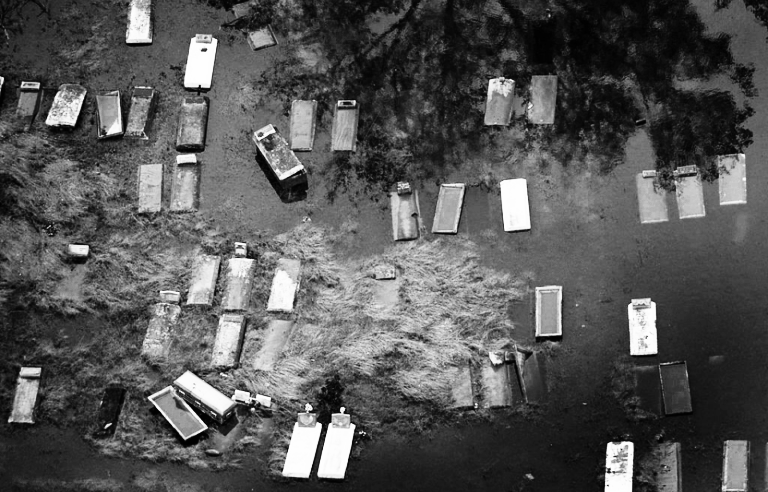
Climate Change and Cemeteries: Rising Sea Levels, Sinking Graves
What About Water Cremation?
One alternative attracting attention is alkaline hydrolysis, sometimes called water cremation or aquamation.
Instead of using flame, alkaline hydrolysis uses water, heat, pressure, and alkaline chemicals to accelerate the natural decomposition of organic tissue. Bone material remains afterward and can be processed and returned to families in a form broadly analogous to cremated remains.
Supporters argue that the process can require less energy and produce fewer direct air emissions than conventional flame cremation.
However, availability and legality vary considerably between jurisdictions. Infrastructure, wastewater regulation, cultural acceptance, and religious attitudes all influence whether the technology is adopted.
Its emergence nevertheless demonstrates something important: the funeral industry is no longer technologically static.
Even death care can be disrupted.
Ash Scattering and Protected Landscapes
Perhaps the most complicated situations arise when people wish to scatter ashes in national parks, historic sites, nature reserves, heritage landscapes, or other protected places.
Emotionally, the desire makes perfect sense. People often choose landscapes that held meaning for the deceased.
Administratively, things become less romantic.
Protected sites may regulate scattering because they must balance private remembrance against conservation and public access. Imagine a famous viewpoint gradually accumulating plaques, flowers, candles, urns, and informal memorial structures. What begins as an intimate gesture can slowly alter the character of a shared landscape.
This raises an intriguing ethical question: does personal grief give us the right to permanently modify public space?
There is no universal answer. But environmentally responsible remembrance should recognise that meaningful landscapes belong to ecosystems and communities as well as memories.
Can Cremation Ashes Be Made More Plant-Friendly?
Yes, although this requires understanding what plants actually need.
Rather than treating cremated remains as ordinary fertilizer, various approaches seek to modify or dilute them before incorporating them into planting environments. Soil amendments can help address pH and salinity, while purpose-designed memorial planting systems separate or condition the remains to reduce stress on roots.
The essential idea is simple: do not expect a plant to adapt to a concentrated material merely because the symbolism is appealing.
If you are planning a memorial tree, professional advice from a horticulturist, cemetery landscape manager, or appropriately qualified memorial provider can be worthwhile, particularly if the entire quantity of cremated remains will be incorporated into a relatively small planting area.
The goal, after all, is a memorial tree—not a memorial dead tree.
Cemeteries, Cremation Gardens, and the Changing Landscape of Memory
The increasing popularity of cremation has also transformed cemetery design.
Historically, cemeteries were landscapes organised around bodies occupying individual plots. Cremation breaks that spatial equation. One person’s remains can occupy a tiny niche, rest beneath a communal memorial, be scattered across a garden, remain at home, or disappear entirely into a landscape.
This has profound implications for cemetery architecture and urban planning.
Columbaria allow large numbers of people to be memorialised within relatively compact structures. Memorial gardens create collective landscapes rather than conventional rows of graves. Some cemeteries incorporate woodland burial areas or multifunctional green spaces.
In other words, cremation is not merely changing what happens to bodies. It is changing the geography of memory.
For scholars of cemeteries, architecture, anthropology, and urban history, this transformation deserves far more attention than the humble urn might initially suggest.
Toward a More Environmentally Responsible Death
Perhaps the most useful lesson is that there is no perfectly impact-free funeral.
Human beings consume resources while alive, and apparently we remain somewhat demanding after death.
Nevertheless, choices matter.
Families concerned about environmental impact can examine the cremation technology available locally, reduce unnecessary funeral products, choose appropriate urn materials, avoid releasing synthetic objects into natural environments, follow regulations, and select scattering or memorial locations carefully.
Most importantly, we can stop treating environmental responsibility and meaningful mourning as opposing goals.
Rituals evolve. They always have.
The elaborate cemetery landscapes of the nineteenth century were themselves innovations. Cremation transformed twentieth-century death practices. Green burial, alternative cremation technologies, digital memorialisation, and ecological cemetery design may transform the twenty-first.
Our rituals for the dead have never been frozen in time—even when their monuments are carved in stone.
Bottom Line
Cremation ashes carry enormous symbolic weight, yet environmentally they are surprisingly misunderstood. They are not ordinary wood ash, they are not automatically useful fertiliser, and they do not simply vanish without consequence wherever we scatter them.
At the same time, cremated remains should not be treated as some sinister environmental pollutant. Their impact depends largely on concentration, location, soil conditions, surrounding ecosystems, and the practices accompanying their disposal.
Perhaps that is the most useful distinction between myth and fact. Environmental questions surrounding death rarely produce neat answers because funeral practices exist at the intersection of chemistry, ecology, culture, law, religion, economics, and grief.
And that intersection is precisely what makes cemeteries—and everything we do with our dead—so revealing.
How we dispose of human remains tells us what we believe about death. How carefully we consider the landscape afterward may tell future generations what we believed about the living world too.
Leave a Reply