Visiting the Catacombs of Paris: What Lies Beneath the City of Light
Paris is celebrated as the City of Light. Visitors arrive expecting elegant boulevards, charming cafés, world-famous museums, and iconic landmarks like the Eiffel Tower and Notre-Dame Cathedral. Yet beneath its romantic streets lies another city—one without sunlight, bustling cafés, or fashionable boutiques. Instead, it is a silent labyrinth lined with the remains of more than six million people.
The Catacombs of Paris are far more than a tourist attraction. They represent one of the world’s most fascinating intersections of urban planning, history, engineering, archaeology, religion, and mortality. Hidden nearly twenty meters beneath the French capital, this underground ossuary tells a story that stretches across centuries, revealing how a growing city confronted one of its greatest public health crises.
Why are millions of skeletons beneath Paris? How did an abandoned quarry become one of the world’s most famous burial sites? And why are so many visitors drawn to a place built entirely around death?
Like an old manuscript hidden beneath a masterpiece, the Catacombs reveal a forgotten chapter of Parisian history. Every tunnel, every carefully arranged skull, and every stone corridor whispers stories of plague, revolution, faith, engineering, and remembrance.
Understanding the Catacombs means looking beyond the bones. It means uncovering the fascinating relationship between the living city above and the silent city below.
The Origins: A City Built on Stone
Long before Paris became Europe’s cultural capital, its underground served a very different purpose.
Beginning in Roman times and expanding throughout the Middle Ages, vast quantities of limestone were extracted beneath the city. This stone became the literal foundation of Paris. It built churches, castles, bridges, universities, monasteries, and eventually landmarks such as Notre-Dame Cathedral and the Louvre.
Imagine the city as an enormous tree. The magnificent buildings above ground are its branches, while the abandoned quarries below are its roots.
As centuries passed, miners dug increasingly complex networks beneath the expanding city. Many tunnels were poorly documented, creating a confusing maze that stretched for hundreds of kilometers.
At first, nobody imagined these empty quarries would eventually house millions of human remains.
A Growing Crisis: Paris Runs Out of Burial Space
By the eighteenth century, Paris faced an unexpected problem.
The city had become densely populated, yet its cemeteries remained relatively small. Most burials occurred within churchyards located in the heart of residential neighbourhoods.
The largest of these was the Cemetery of the Holy Innocents (Les Innocents), which had served Parisians for nearly a thousand years.
For centuries, bodies were buried repeatedly in the same limited space.
Eventually, the cemetery became dangerously overcrowded.
Mass graves were reopened repeatedly to accommodate new burials. Decomposition contaminated nearby wells. The smell became unbearable during warm weather. In some locations, the sheer pressure of accumulated remains caused cemetery walls to collapse into neighbouring cellars.
Death had literally become part of daily life.
What had once been sacred ground slowly transformed into a public health emergency.
When the Dead Threatened the Living
The crisis reached its breaking point in 1780.
After prolonged rainfall, part of the wall surrounding Les Innocents collapsed. Human remains spilled into the basement of a nearby property, shocking residents and forcing city officials to confront a problem they had ignored for decades.
Authorities concluded that Paris could no longer continue burying its dead within crowded urban cemeteries.
A radical solution emerged.
Rather than creating another cemetery inside the city, officials would relocate centuries of human remains into the abandoned limestone quarries beneath Paris.
It was an enormous undertaking unlike anything Europe had attempted before.
The Creation of the Paris Ossuary
Beginning in 1786, workers began transferring bones from Parisian cemeteries into the underground tunnels.
The process took place almost exclusively at night.
Covered wagons transported remains through silent streets accompanied by priests chanting funeral prayers. This solemn procession continued for years.
Initially, the bones were simply stacked inside the abandoned quarries.
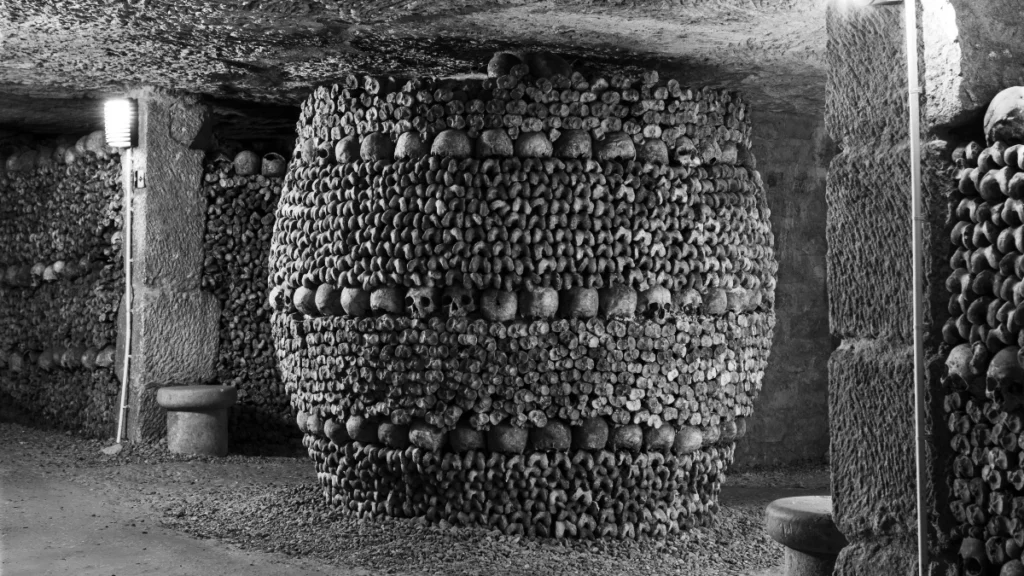
Only decades later did engineers and inspectors transform these chaotic piles into the carefully organized displays visitors see today.
The result became known as the Municipal Ossuary of Paris, although today the world simply calls it the Catacombs of Paris.
Ironically, a place created to solve a sanitation crisis evolved into one of France’s most remarkable historical monuments.
More Than Bones: Engineering an Underground City
One common misconception is that the Catacombs of Paris consist solely of skeletons.
In reality, the ossuary occupies only a small portion of an immense underground network.
The larger tunnel system extends for approximately 300 kilometers (186 miles), although only a carefully controlled section is open to visitors.
Maintaining these tunnels has always required remarkable engineering.
During the eighteenth century, inspectors discovered that abandoned quarries threatened the stability of buildings above ground. Entire neighbourhoods risked collapse.
To address this danger, King Louis XVI established the General Inspectorate of Quarries in 1777.
Its mission was ambitious:
- Map the underground.
- Reinforce unstable tunnels.
- Prevent sinkholes.
- Preserve the city’s foundations.
Without these engineers, modern Paris might look very different today.
The Catacombs therefore represent not only a cemetery but also one of Europe’s earliest examples of large-scale urban infrastructure management.
The Art of Arranging the Dead
Perhaps the most striking feature of the Catacombs is their appearance.
Visitors often imagine chaotic piles of skeletons.
Instead, they encounter remarkable symmetry.
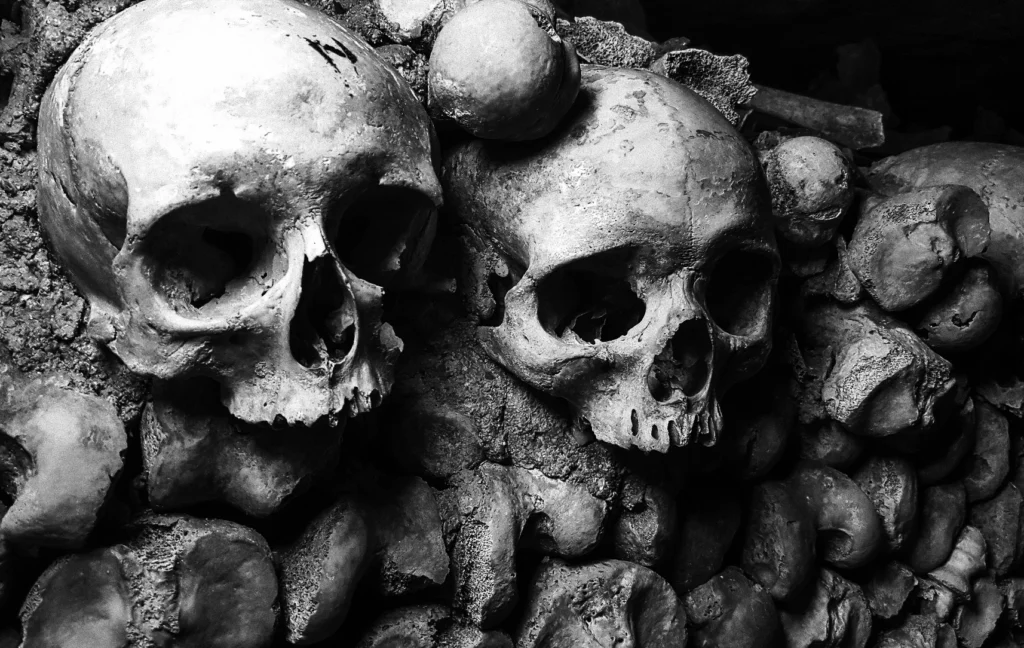
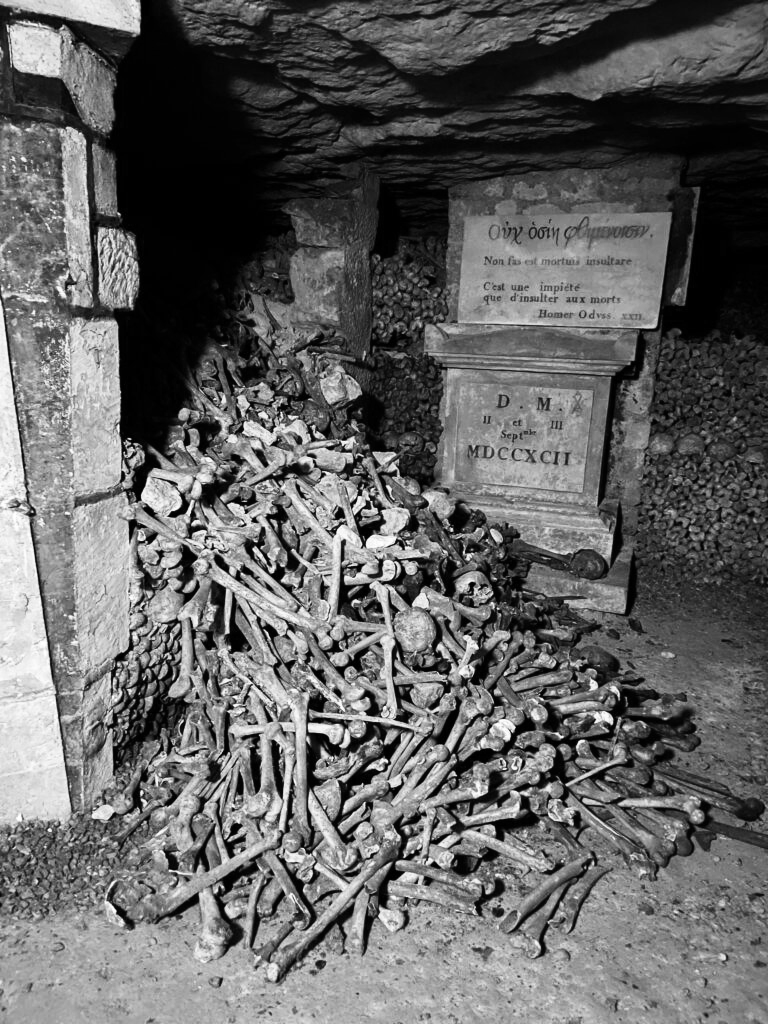
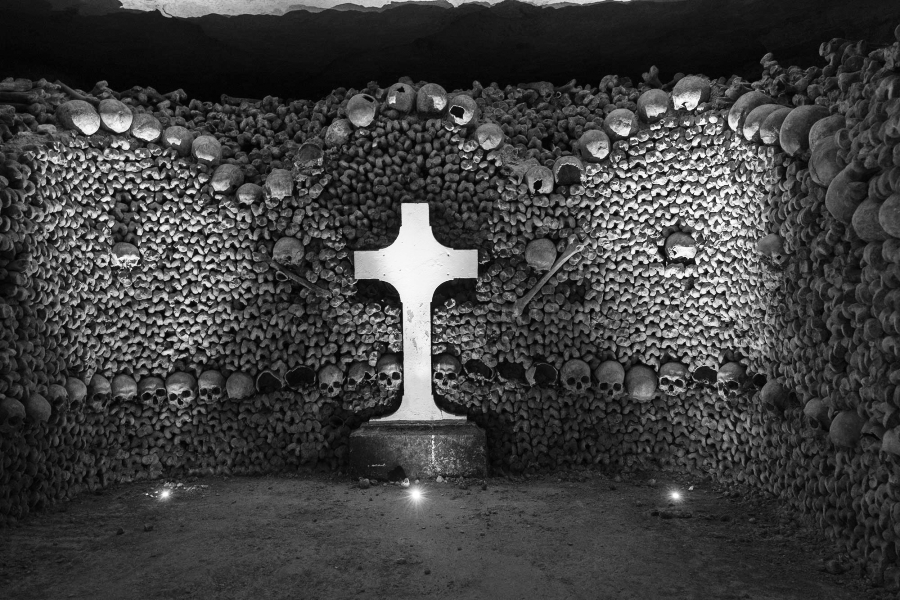
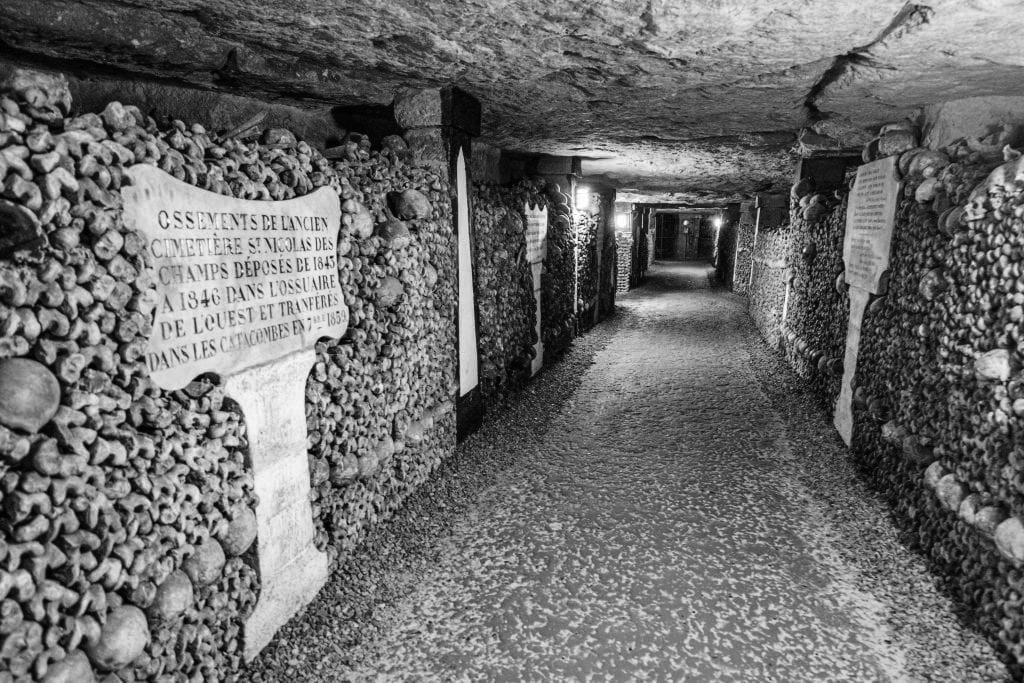
Walls composed of neatly arranged skulls alternate with patterns created from femurs and tibias. Behind these decorative facades lie countless additional bones stacked for structural support.
Why arrange them so carefully?
The answer is partly practical and partly symbolic.
Organised walls stabilised enormous quantities of remains while creating a solemn visual language. Rather than emphasising horror, the arrangement encourages contemplation.
The skulls no longer represent individuals.
Together, they symbolise humanity itself.
It is impossible to distinguish kings from servants, philosophers from labourers, nobles from revolutionaries.
Death becomes the great equalizer.
Philosophy Carved in Stone
Throughout the Catacombs, visitors encounter inscriptions carved into the walls.
One of the most famous reads:
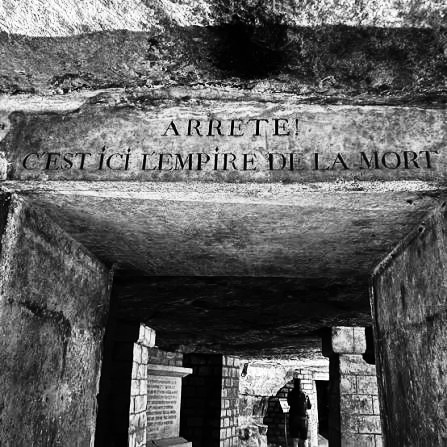
“Arrête! C’est ici l’empire de la Mort.”
Translated, it means:
“Stop! Here lies the Empire of Death.”
This dramatic entrance prepares visitors psychologically.
The Catacombs were never intended as entertainment.
Instead, they function almost like a philosophical journey.
Many inscriptions quote classical authors, biblical passages, or reflections on mortality.
They invite visitors to pause and ask timeless questions.
What remains after death?
How should we remember those who came before us?
What does it mean to leave a legacy?
These corridors become less like museum galleries and more like chapters in an ancient meditation on the human condition.
The French Revolution and the Catacombs
The timing of the Catacombs’ creation placed them at the center of one of history’s most turbulent periods.
Only a few years after the first transfers began, the French Revolution erupted.
Thousands lost their lives during the Reign of Terror.
Many victims—including revolutionaries, aristocrats, clergy, and ordinary citizens—were buried in various Paris cemeteries before later becoming part of the underground ossuary.
Consequently, the Catacombs of Paris contain the remains of people from every social class.
Some may have shaped French history.
Others lived anonymous lives.
Today, they rest together without distinction.
History has erased hierarchy.
A Hidden World Inspiring Curiosity
Although the Catacombs remained largely inaccessible to the public for many years, they gradually became objects of fascination.
Writers, artists, archaeologists, and scholars visited the tunnels, each interpreting them differently.
Some viewed them as symbols of mortality.
Others admired the extraordinary engineering.
Romantic-era writers saw poetry in the silence, while early historians recognised an unparalleled archive of urban history.
Over time, the Catacombs transformed from a practical municipal solution into one of Paris’s most intriguing cultural landmarks.
They challenge visitors to reconsider familiar assumptions about cities.
After all, how many great capitals literally rest upon the remains of millions of former inhabitants?
Exploring the Catacombs of Paris Today: A Journey Unlike Any Other
Stepping into the Catacombs of Paris feels less like entering a museum and more like crossing a threshold between two worlds. The lively cafés, busy boulevards, and elegant architecture of Paris fade away as visitors descend a narrow spiral staircase nearly 20 meters (65 feet) beneath the city’s streets.
The descent itself is symbolic. Each step moves you further from modern life and closer to centuries of history.
The air becomes noticeably cooler. Sound is muted. Humidity rises. The bustling metropolis above is replaced by an almost monastic silence interrupted only by distant footsteps and whispered conversations.
Unlike many historical attractions that rely on multimedia displays or interactive exhibits, the Catacombs need very little interpretation. The environment speaks for itself.
Visitors walk approximately 1.5 kilometers (just under one mile) through underground galleries before reaching the famous ossuary. Along the way, informative plaques explain the geological history of the former limestone quarries, providing valuable context before the emotional impact of the bone-lined corridors begins.
Then comes the famous inscription:
“Stop! Here is the Empire of Death.”
Few museum entrances are quite so memorable.
The Cataphiles: The Secret Explorers Beneath Paris
Not every visitor to the Catacombs enters through the official entrance.
Hidden beneath Paris exists an entire subculture known as the cataphiles—urban explorers who venture into sections of the underground network closed to the public.
Some enter through forgotten maintenance tunnels, hidden manholes, or abandoned access points. Others spend years learning complex maps of the labyrinth.
Why?
For many, it isn’t about breaking the law. It’s about exploration, history, photography, and preserving an underground heritage invisible to most Parisians.
Within these restricted tunnels, explorers have discovered forgotten inscriptions, abandoned shelters from World War II, hidden sculptures carved directly into limestone, underground chapels, and even secret gathering places.
Some areas reportedly contain makeshift cinemas, libraries, art installations, and meeting rooms created entirely beneath the city.
However, entering these restricted sections is illegal and potentially dangerous.
The labyrinth stretches for hundreds of kilometers. Without detailed knowledge, it is surprisingly easy to become lost.
Like the sea, the underground rewards preparation and punishes overconfidence.
The Catacombs During World War II
History continued unfolding beneath Paris during the Second World War.
During the German occupation, portions of the underground tunnels served both Allied resistance fighters and German military forces.
The French Resistance established hidden headquarters within the quarry network, taking advantage of its complexity to organise communications and avoid detection.
Ironically, German forces also constructed underground bunkers elsewhere within the same network.
It is one of history’s fascinating paradoxes.
Above ground, occupation divided the city.
Below ground, opposing forces operated within the same hidden world.
The Catacombs therefore preserve not only centuries of funerary history but also an important chapter in twentieth-century European history.
Art Beneath the Earth
Many visitors expect only bones.
Instead, they discover art.
Throughout the underground network are remarkable stone carvings created by former quarry workers and later explorers.
One of the most famous artists was Décure, a quarry worker during the late eighteenth century who transformed ordinary limestone into elaborate sculptures depicting castles, churches, and miniature fortresses.
His creations remain astonishing examples of underground craftsmanship.
Elsewhere, visitors encounter carefully carved pillars, decorative walls, engraved quotations, and architectural reinforcements that demonstrate both engineering skill and artistic ambition.
Even the arrangement of the bones reflects intentional design.
Rows of skulls alternate with femurs like carefully composed mosaics.
The result is strangely beautiful—not because it glorifies death, but because it transforms disorder into dignity.
Death as Design: The Architecture of Memory
At first glance, arranging human bones into decorative walls may seem unsettling.
Yet there is profound symbolism behind these compositions.
The architects responsible for organising the ossuary understood that they were creating more than storage space.
They were designing memory.
The repetitive patterns encourage reflection rather than fear.
Individual identity disappears, replaced by collective humanity.
Every skull becomes part of a larger story.
It is much like viewing stars in the night sky. Individually they are points of light. Together they create constellations that help us understand something larger than ourselves.
The Catacombs invite precisely this perspective.
Rather than asking Who was this person?, visitors begin asking What does it mean that we all end here?
The Ethics of Visiting Human Remains
The popularity of the Catacombs raises important ethical questions.
Is it appropriate to visit a place containing the remains of millions of people?
Opinions differ.
Some critics argue that the Catacombs risk transforming human remains into entertainment.
Others believe public access preserves historical memory and encourages respectful reflection on mortality.
The difference often lies in visitor behaviour.
Responsible visitors recognise that this is not a haunted house or horror attraction.
It is an ossuary.
Photography is permitted, but climbing over barriers, touching the bones, or treating the site as a backdrop for sensational social media content shows little respect for those whose remains rest there.
Perhaps the simplest guideline is this:
Visit with curiosity—but also with humility.
The Catacombs and Dark Tourism
The Catacombs of Paris have become one of the world’s best-known examples of dark tourism—travel to places associated with death, tragedy, or historical suffering.
Yet the term “dark tourism” can sometimes be misleading.
Many visitors are not seeking thrills.
Instead, they seek understanding.
Death has always fascinated humanity because it reminds us of life’s fragility.
Just as battlefields help us understand war, and memorial museums help us understand genocide, the Catacombs help us understand urban history, public health, religion, architecture, and the changing relationship between society and death.
Seen through this lens, the Catacombs become less about skeletons and more about civilisation itself.
Practical Tips for Visiting the Catacombs of Paris
Planning ahead can significantly improve your experience.
Book Tickets in Advance
The Catacombs are one of Paris’s most popular attractions, and visitor numbers are limited each day. Reserving tickets online well before your visit is strongly recommended, particularly during spring and summer.
Wear Comfortable Shoes
Although the route is well maintained, visitors walk more than a kilometer through uneven underground passages and climb numerous stairs.
Comfort matters.
Bring a Light Jacket
The temperature remains relatively constant throughout the year at around 14°C (57°F).
Even during the hottest Parisian summer, the underground feels cool.
Consider Accessibility
Unfortunately, the Catacombs are not fully accessible to visitors with reduced mobility due to the numerous staircases and narrow passages.
Allow Plenty of Time
Most visits last between 45 minutes and one hour, although history enthusiasts often spend longer examining the displays and reading the interpretive panels.
Take your time.
The Catacombs reward slow observation.
Why the Catacombs Continue to Fascinate
What explains their enduring appeal?
Perhaps it is because the Catacombs combine so many disciplines in one extraordinary place.
They are simultaneously:
- An archaeological site.
- A geological landscape.
- An engineering achievement.
- A historical archive.
- A philosophical monument.
- A work of funerary art.
- A reminder of urban resilience.
Few destinations offer such intellectual richness.
The Catacombs challenge simplistic ideas about death.
Rather than hiding mortality, they confront it directly.
And strangely enough, that confrontation often leaves visitors appreciating life even more.

Unexpected Beauty: The Hidden Charm of Small, Local Cemeteries
Strange Encounters in Graveyards: Personal Stories & Readers Submissions
Lessons from the Underground
The greatest lesson of the Catacombs may have nothing to do with death.
Instead, it concerns memory.
Cities constantly reinvent themselves. Buildings rise and fall. Streets change names. Generations come and go.
Yet beneath modern Paris lies an extraordinary reminder that every vibrant city rests upon countless forgotten lives.
The Catacombs invite us to acknowledge those invisible foundations.
Without the labourers, merchants, artists, children, priests, revolutionaries, soldiers, and ordinary citizens whose remains now rest underground, Paris would not exist as we know it today.
The City of Light owes part of its brilliance to the silent city beneath.
Bottom Line
The Paris Catacombs are far more than an underground cemetery. They are one of the world’s most remarkable examples of how history, engineering, art, urban planning, and philosophy converge beneath a modern metropolis.
What began as abandoned limestone quarries became the solution to an eighteenth-century public health crisis. Over time, those practical tunnels evolved into a powerful memorial where millions of anonymous lives are remembered collectively rather than individually. Every carefully arranged skull, every carved inscription, and every stone corridor tells a story about the relationship between cities and their dead.
For historians, the Catacombs reveal the evolution of Paris. For architects, they demonstrate remarkable engineering. For philosophers, they provoke reflection on mortality. And for travelers, they offer an unforgettable experience unlike any other attraction in the French capital.
In the end, perhaps the greatest surprise is not what lies beneath Paris—but what the Catacombs reveal about ourselves. They remind us that every city has hidden layers, every civilisation leaves traces, and every life, however ordinary, becomes part of a much larger human story.
FAQs
*Photos by Talita Soncini
Leave a Reply