Should Cemeteries Be Open to the Public for Leisure Activities?
Cemeteries are strange places. They are public, yet intensely private. They belong to cities, religious communities, institutions, and families, yet they also belong, in a less tangible sense, to the dead. They are landscapes designed to be entered but governed by an unwritten expectation that visitors should behave differently once they cross the gates.
And then someone goes jogging through one.
Suddenly, a deceptively simple question emerges: what exactly is a cemetery for?
Should cemeteries be reserved primarily for burial, mourning, and remembrance, or can they also function as parks, heritage sites, walking routes, ecological reserves, and places of everyday recreation?
The debate is not as modern as it might appear. Historically, cemeteries have often occupied a complicated position between sacred ground and public landscape. Some were deliberately designed for walking and contemplation. Others became informal recreational spaces because densely populated cities offered residents few alternatives.
Today, as cities search for green space and historic cemeteries increasingly function as cultural attractions, the question has acquired new urgency. Opening cemeteries to leisure activities can bring enormous social and environmental benefits. But where does public enjoyment end and disrespect begin?
The answer may depend less on whether people use cemeteries recreationally than on how they use them.
Cemeteries Were Not Always Solemn Places
Our contemporary image of the cemetery as a place where one should whisper, walk slowly, and look suitably contemplative is historically specific.
Burial grounds have served multiple social functions for centuries. Medieval churchyards, for example, were not isolated landscapes visited exclusively by mourners. They existed at the centre of community life. People crossed them, gathered around churches, conducted business nearby, and encountered the dead as part of everyday existence.
The modern separation between the living and the dead developed gradually.
By the 18th and particularly the 19th century, rapidly expanding European and North American cities faced increasingly serious problems with overcrowded urban burial grounds. Reformers advocated large cemeteries outside congested centres, and a new landscape emerged: the garden cemetery.
These cemeteries were not simply fields filled with graves. They were carefully designed environments incorporating winding paths, trees, picturesque views, sculptures, architectural monuments, and landscaped vegetation.
In other words, they looked suspiciously like parks.
And people treated them accordingly.
The Garden Cemetery Was Part Cemetery, Part Public Landscape
The 19th-century garden cemetery movement complicates any argument that recreational use is inherently incompatible with burial grounds.
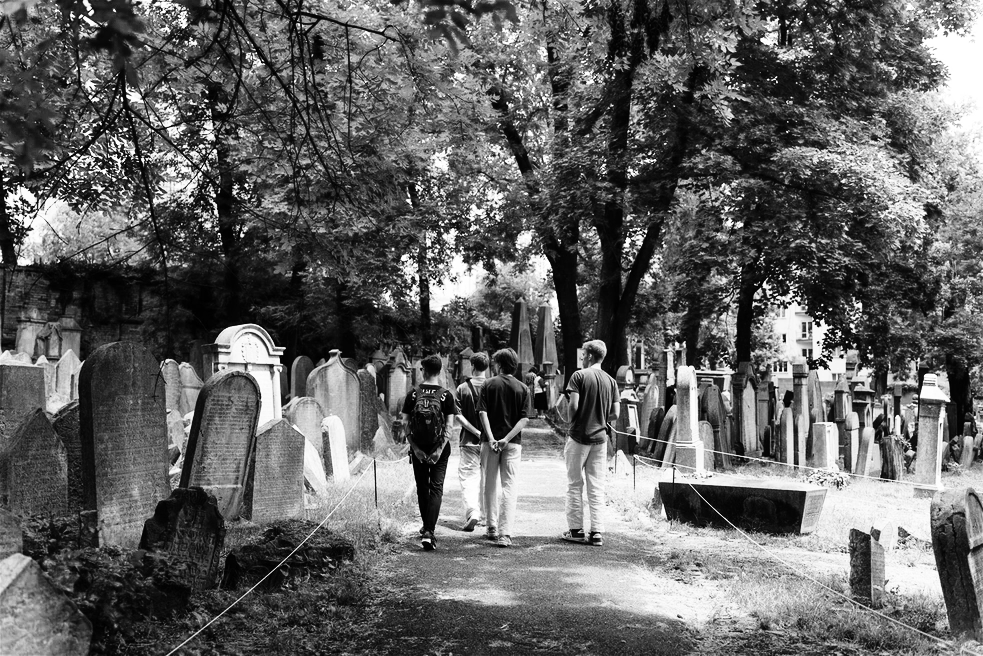
Cemeteries such as Père Lachaise in Paris, Mount Auburn near Boston, and Highgate in London combined burial with landscape design. Visitors came not merely to mourn relatives but also to walk, admire monuments, contemplate nature, and observe the architecture of death.
The cemetery became something approaching an outdoor museum crossed with a landscaped garden.
Indeed, before municipal public parks became widespread, landscaped cemeteries provided urban populations with access to greenery that could otherwise be difficult to find.
This history matters because it reveals that the boundary between cemetery and park has never been absolute. The idea that leisure somehow contaminates the cemetery assumes that cemeteries were always exclusively funerary environments.
They were not.
However, there is an obvious distinction between strolling beneath trees and holding a football match between the headstones. Historical precedent can justify multifunctionality, but it does not automatically justify every activity imaginable.
The Modern Cemetery as Urban Green Space
Today, the debate has acquired another dimension: cities desperately need green space.
Large historic cemeteries can contain mature trees, extensive vegetation, relatively undisturbed soil, and habitats that have survived while surrounding districts became increasingly developed.
From an urban-planning perspective, that makes them extraordinarily valuable.
A cemetery can contribute to urban cooling, biodiversity, rainwater absorption, habitat connectivity, and psychological access to nature. For residents of densely built neighbourhoods, it may also represent one of the largest accessible green spaces within walking distance.
Should such landscapes remain socially underused simply because they contain graves?
The answer is not obvious.
Walking through a cemetery does not prevent it from functioning as a burial ground. Nor does sitting beneath a tree necessarily diminish the dignity of the people buried nearby.
In fact, allowing appropriate public use may help integrate cemeteries into urban life rather than turning them into neglected islands surrounded by development.
There is something rather ironic about preserving enormous green spaces in the middle of crowded cities while insisting that the living should barely use them.
Walking Is Easy. What About Jogging?
This is where things become interesting.
Most people would probably accept someone walking through a cemetery. What about jogging?
Cycling? Reading on a bench? Sketching? Birdwatching? Having lunch? Walking a dog? Yoga? A picnic?
The further we travel down that list, the less comfortable some readers will become.
Yet identifying precisely where the problem begins is surprisingly difficult.
Is jogging disrespectful because it is exercise? If so, why is brisk walking acceptable? Is reading a novel beside a grave inappropriate while reading an epitaph is not? Is eating offensive because cemeteries are associated with death, despite the long history of funerary meals and communal remembrance?
Our reactions reveal something important: cemetery etiquette is culturally constructed rather than self-evident.
Different societies maintain different relationships with burial grounds. Activities considered shocking in one cultural context may be ordinary components of remembrance in another.
The question therefore cannot simply be, “Is recreation disrespectful?”
We need to ask: Which recreation, in which cemetery, under what circumstances?
The Argument for Opening Cemeteries to Leisure
There are several strong arguments for allowing controlled leisure activities in cemeteries.
The first is straightforward: public use encourages public engagement.
A cemetery that residents regularly walk through becomes part of the neighbourhood’s mental geography. People notice damaged monuments, fallen branches, vandalism, and neglected areas. Familiarity can generate stewardship.
A cemetery hidden behind locked gates, by contrast, risks becoming culturally invisible.
Public use can also increase appreciation of funerary art and history. Someone who initially enters because the cemetery provides a pleasant walking route may eventually begin reading inscriptions, noticing sculpture, or becoming curious about the people buried there.
Leisure can therefore become a gateway to heritage.
There are health benefits too. Quiet green environments provide opportunities for walking, contemplation, and contact with nature. Cemeteries can offer something conventional parks often cannot: stillness.
Perhaps that is precisely their appeal.
Who Owns the Dead? Legal & Moral Dilemmas in Cemetery Management
The Ethics of Cemetery Tourism: Respect vs. Curiosity
Cemeteries as Museums Without Roofs
Historic cemeteries are also enormous archives.
Their monuments record changing artistic styles, religious beliefs, occupations, migration patterns, family structures, epidemics, wars, infant mortality, class divisions, and attitudes towards gender.
Walk through an old cemetery carefully enough and you are effectively reading a city written in stone.
Restricting cemeteries exclusively to mourners can therefore conflict with another important function: heritage education.
Guided tours, historical walks, photography, architectural study, school visits, botanical tours, and genealogical research all involve using cemetery space for purposes other than mourning.
Few would describe a historian examining gravestones as disrespectful.
But technically, that historian is engaging in an activity unrelated to visiting a deceased loved one.
Once we accept educational and cultural uses, the absolute division between funerary and non-funerary activity begins to collapse.
But Cemeteries Are Not Ordinary Parks
None of this means cemeteries should simply become parks with unusually elaborate landscaping.
There is a fundamental difference.
People are buried there.
More importantly, living people continue to maintain emotional relationships with those graves.
For a visitor, a Victorian monument might be a beautiful example of funerary sculpture. For someone else, the grave beside it may contain their mother.
That distinction matters enormously.
Recreational planning therefore needs to recognise what we might call emotional ownership. A cemetery may legally be public property while simultaneously containing thousands of spaces that individuals experience as deeply personal.
Imagine attending the funeral of someone you love while cyclists speed past the procession or a group nearby spreads out a picnic blanket.
The problem becomes immediately apparent.
Public access cannot mean unrestricted use.
The Difference Between Passive and Active Recreation
One useful approach is to distinguish between passive and active recreation.
Passive activities generally require little infrastructure and create minimal disturbance. Walking, reading, drawing, photography, birdwatching, historical exploration, and quiet contemplation fall broadly within this category.
Active recreation is different. Running events, organised sports, loud gatherings, cycling at speed, parties, and similar activities can conflict much more directly with funerary functions.
The distinction is imperfect. A respectful jogger may cause considerably less disturbance than an obnoxiously loud historical tour group.
Nevertheless, the passive-active framework provides cemetery managers with a practical starting point.
Rather than asking whether leisure should be permitted, authorities can ask which activities remain compatible with the primary funerary and commemorative function of the landscape.
That is a much better question.
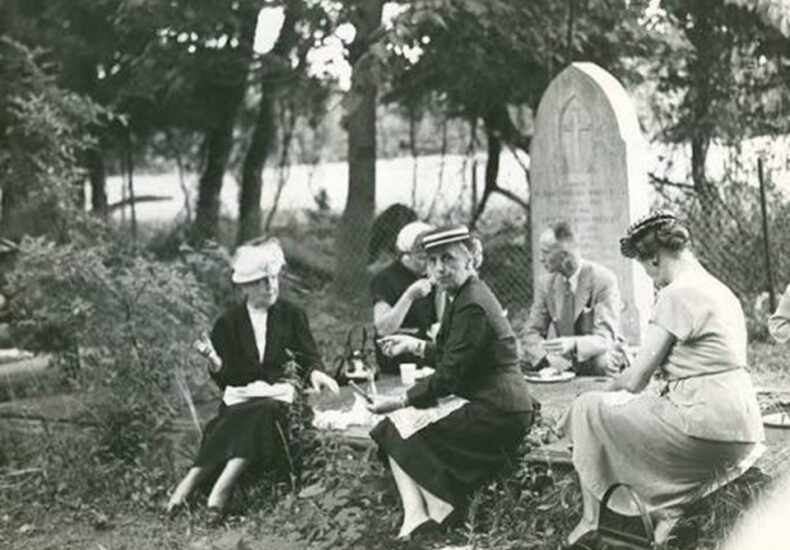
What About Picnics Among the Dead?
Few activities expose our assumptions about cemeteries quite as effectively as picnicking.
To many modern Western visitors, eating beside graves feels instinctively inappropriate.
Yet food and death have been companions for millennia.
Funerary meals, offerings to the dead, commemorative feasts, and gatherings at graves occur across numerous cultures. In some traditions, sharing food near burial sites is not disrespectful at all. It reinforces the continuing relationship between living communities and their ancestors.
The objection, then, is not necessarily to food itself.
It is often to context.
A family sharing food while commemorating a relative communicates something very different from tourists placing disposable cups on a tomb because they needed somewhere to sit.
The physical action may appear similar. The meaning is not.
This is why cemetery behaviour cannot be regulated effectively through simplistic assumptions about what “looks respectful.”
The Problem of Tourism
Historic cemeteries already receive enormous numbers of recreational visitors, whether we acknowledge them as recreational spaces or not.
People visit Père Lachaise to see Oscar Wilde and Jim Morrison. They visit Highgate for its Gothic architecture and famous residents. They photograph monumental cemeteries in Milan, Genoa, Buenos Aires, and elsewhere because the sculpture rivals that of conventional museums.
Cemetery tourism can generate funding, public awareness, and support for conservation.
It can also produce profoundly strange behaviour.
Visitors climb monuments for photographs. Famous graves become crowded attractions. People leave rubbish, graffiti, lipstick marks, alcohol bottles, and objects that may damage historic stone.
The problem here is not tourism itself.
It is the transformation of a place of memory into a consumable backdrop.
A cemetery can be appreciated aesthetically without forgetting what it is.
That balance should sit at the heart of responsible cemetery tourism.
Could Public Use Actually Help Preserve Cemeteries?
There is another practical argument for greater public engagement: historic cemeteries are expensive to maintain.
Stone deteriorates. Vegetation grows. Trees fall. Paths require repair. Drainage systems fail. Mausoleums become unstable. Records need preservation.
Meanwhile, many historic cemeteries no longer generate substantial revenue from new burials.
Opening them to carefully managed cultural and recreational use can attract visitors, volunteers, donations, heritage funding, and political attention.
A cemetery people care about is considerably easier to defend than one they have never entered.
Public engagement may therefore become part of conservation itself.
There is a paradox here worth considering. Excessive visitation can damage cemeteries, but complete isolation can contribute to their neglect.
The solution lies somewhere between abandonment and amusement park.
Design Can Mediate the Conflict
As with many disputes over public space, thoughtful design can solve problems that moral arguments alone cannot.
Not every part of a cemetery needs to serve the same purpose.
Areas containing active burials could maintain stricter behavioural expectations, while historic sections with few contemporary interments might accommodate greater recreational use.
Paths could direct through-traffic away from graves. Designated seating areas could encourage visitors to rest without sitting on monuments. Cycling could be restricted to particular routes. Dog access could be controlled. Events could occur only in designated areas and outside funeral hours.
Clear signage can communicate expectations without making visitors feel they have entered a military compound.
In other words, zoning can allow multiple meanings to coexist.
Urban planners already design parks to accommodate incompatible activities. Children’s playgrounds are separated from quiet gardens; cycling routes are distinguished from pedestrian paths.
Why should cemetery landscapes be treated as incapable of similar nuance?
Respect Should Be the Governing Principle
Perhaps the most useful distinction is not between mourning and leisure at all.
It is between respectful and disrespectful use.
A woman reading quietly beneath a tree is engaged in leisure, but she poses little threat to the cemetery’s dignity. Someone photographing a sculpture for an architectural study is technically using the cemetery recreationally. So is a birdwatcher.
Meanwhile, someone visiting a relative’s grave can still behave disrespectfully toward neighbouring graves.
Purpose alone does not determine behaviour.
Respect does.
A reasonable cemetery policy might therefore permit activities that do not interfere with funerals, damage monuments, invade mourners’ privacy, create excessive noise, or treat graves as recreational equipment.
That still leaves plenty of room for the living.
A Cemetery Can Belong to Both the Living and the Dead
Perhaps our discomfort with recreational cemeteries comes from the modern tendency to separate death from everyday life.
We place the dead in designated landscapes. Professionals handle bodies. Funerals occur within carefully managed spaces. Cemeteries often sit behind walls and gates.
Death becomes geographically contained.
Allowing ordinary life back into cemeteries disrupts that separation.
Someone walks their morning route beneath memorial trees. A student sketches an angel. An elderly couple rests on a bench. A historian photographs inscriptions. Children ask their parents what the stones mean.
Perhaps that is not a failure of respect.
Perhaps it is one way of preventing cemeteries—and the people within them—from disappearing from collective memory.
The dead do not necessarily need silence.
They need remembrance.
Bottom Line
Treating every cemetery as an untouchable landscape reserved exclusively for mourning ignores the complex history of burial grounds as social, cultural, ecological, and landscaped spaces. Particularly in dense cities, cemeteries can provide valuable green space while encouraging heritage appreciation, historical research, biodiversity, and public engagement.
But turning cemeteries into ordinary recreational parks would ignore something equally important: these landscapes still contain the dead, and many contain active relationships between mourners and those they have lost.
The best approach is therefore neither prohibition nor unrestricted access. It is carefully managed coexistence.
Walking? Certainly. Reading? Why not? Photography? Respectfully. Historical tours? Absolutely. Jogging? Probably, where local conditions allow it. Loud parties between the mausoleums? Perhaps the municipal park would be a better choice.
Ultimately, the question is not whether the living belong in cemeteries.
They always have.
The real question is whether we can share space with the dead without forgetting that they are there.
Leave a Reply