The Vampire Graves of Europe: Exhumations, Folklore, and Superstitions
Vampires, inconveniently for Gothic literature, did not always wear velvet.
The vampire of European folklore was often something considerably less elegant: a recently deceased neighbour whose body was behaving suspiciously. Perhaps the corpse had not decomposed as quickly as expected. Perhaps blood appeared around its mouth. Perhaps several people in the village had fallen ill after the person’s death. Or perhaps the deceased had simply possessed the sort of reputation that made neighbours uneasy even while they were alive.
Then somebody suggested opening the grave.
Across parts of medieval and early modern Europe, communities developed practices intended to prevent troublesome dead people from returning. Corpses might be decapitated, pinned down with stones, buried face downward, restrained with iron objects or otherwise treated in ways that differed strikingly from conventional burial.
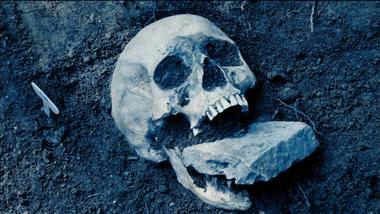
Modern archaeology has uncovered a number of these unusual graves, particularly in Central and Eastern Europe. They are frequently described as “vampire burials.” The phrase is wonderfully clickable. Academically, however, it is considerably more troublesome.
A sickle across a skeleton’s neck does not come with a label reading Here lies a vampire.
What these graves actually reveal is something more interesting: how earlier societies responded to uncertainty surrounding death, disease, decomposition and social disorder.
Before Dracula: The Vampire as a Returning Corpse
Ask someone today to picture a vampire and Bram Stoker’s aristocratic Count Dracula will probably appear somewhere in the imagination. Yet the folkloric beings that preceded him were remarkably diverse.
European traditions contained numerous varieties of revenants—the dead who somehow returned and interfered with the living. In Slavic regions, terms related to upiór, upyr and vampir described supernatural beings whose characteristics varied according to period and place.
These creatures were not necessarily seductive blood drinkers. They could spread illness, attack relatives, disturb livestock or simply refuse to remain properly dead.
That last point matters.
Death might seem biologically straightforward to us, but socially it is a process. A person dies, the body is buried, mourning rituals take place and the deceased gradually moves from the world of the living into the world of ancestors and memory.
The revenant violates that transition.
He—or she—comes back.
The vampire was therefore not merely a monster. It represented a breakdown in the expected relationship between living people, dead bodies and the boundaries separating them.
And sometimes the solution was surprisingly practical: modify the corpse.
What Is a “Vampire Grave”?
Archaeologists sometimes encounter what have historically been called deviant, atypical or non-normative burials.
Instead of being buried according to the usual customs of their community, an individual might be placed face downward, decapitated, restrained by stones, pierced, mutilated or accompanied by objects apparently intended to immobilise the body.
It is tempting to interpret every unusual grave as evidence of supernatural fear. Tempting—and dangerous.
Researchers studying early medieval Polish burials have specifically warned against automatically interpreting decapitation, prone burial or stones placed over bodies as evidence of vampire belief. Such treatments could potentially relate to judicial punishment, social status, execution, marginalisation, unusual circumstances of death or funerary customs whose meaning has simply been lost.
Even the terminology has come under scrutiny. Archaeologist Olga Dec has argued that terms such as “returning dead” or “(un)dead” may sometimes be more appropriate than “vampire,” precisely because the latter imports later folklore and popular culture into archaeological contexts where it may not belong.
So throughout this discussion, “vampire grave” should be understood cautiously. We are examining burials interpreted as involving apotropaic practices—ritual actions intended to protect the living from perceived supernatural danger—not archaeological proof that the occupants were literally identified by their communities using our modern concept of a vampire.
That caveat may spoil a few headlines. It makes the archaeology much better.
Poland and the Archaeology of the Dangerous Dead
Some of the most compelling evidence comes from Poland.
At the seventeenth- and eighteenth-century cemetery of Drawsko 1, archaeologists recovered approximately 285 individuals. Six burials contained particularly unusual features interpreted as apotropaic.
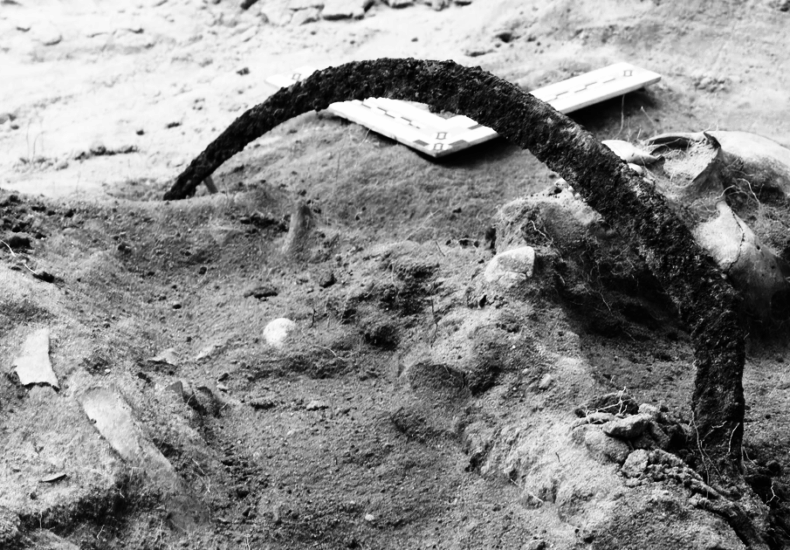
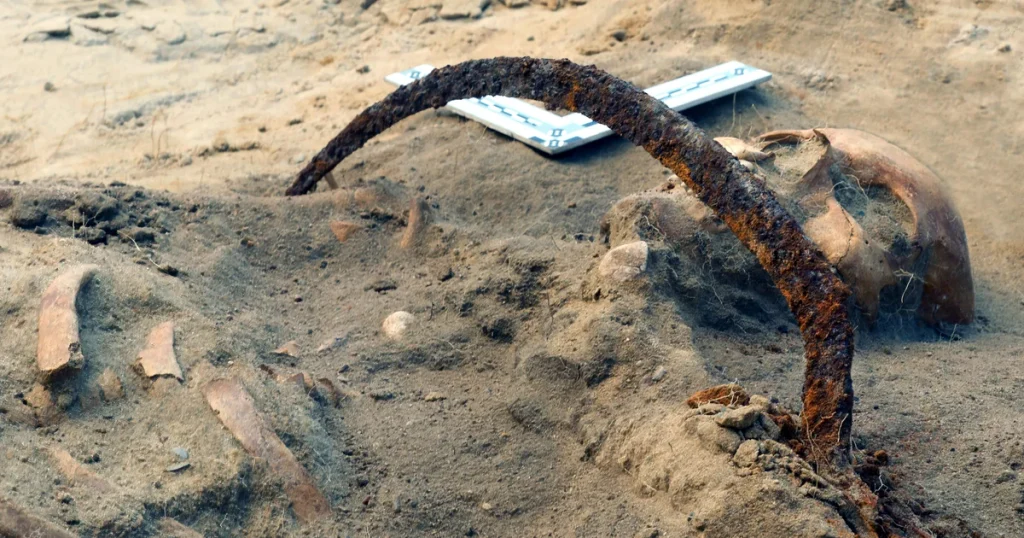
Five individuals had iron sickles positioned across either the throat or abdomen. Two also had large stones placed beneath their chins. Researchers have interpreted these arrangements as precautions intended to prevent the corpse from rising or biting should it somehow become reanimated.
The image is startling: an agricultural implement transformed into supernatural security equipment.
Yet what makes Drawsko particularly valuable is that researchers did not stop at the visual drama of the graves.
They tested the dead.
Strontium isotope analysis was used to investigate whether these individuals might have been outsiders. Perhaps, the researchers wondered, immigrants had attracted suspicion and consequently received unusual burials.
The evidence did not support that explanation. The individuals receiving these treatments had isotope signatures consistent with the local population. Subsequent oxygen and carbon isotope research likewise found no significant difference between the atypical individuals and people receiving conventional burials.
The feared dead, apparently, did not have to be strangers. They could be neighbours.
The Woman of Pień and a Locked Grave
An even more extraordinary Polish burial was discovered at Pień in north-central Poland in 2022.
Grave 75 contained the remains of a young woman dating to the seventeenth century. A sickle had been positioned across her neck and a padlock associated with one of her toes.
A major multidisciplinary study published in 2026 examined the burial using archaeological, osteological, radiocarbon, DNA, textile, elemental and isotopic analyses. The researchers interpreted the grave as displaying anti-demonic protective practices and noted that the combination of sickle and padlock was exceptional in the published archaeological record.
Here the symbolism becomes fascinating.
A sickle is physically capable of cutting.
A lock, however, communicates through metaphor.
To lock something is to close it, contain it and prevent its escape. The object therefore transforms an abstract fear into a physical gesture: the dangerous dead are sealed away.
This is material culture doing psychological work.
The grave becomes less a resting place than a boundary.
The “Vampire of Venice”
The phenomenon was not confined to Eastern Europe.
During archaeological investigations of plague burials on Lazzaretto Nuovo, an island in the Venetian Lagoon, researchers discovered the remains of a woman associated with the sixteenth-century plague period. A brick had apparently been deliberately inserted into her mouth.
Forensic analysis concluded that the position of the brick was intentional rather than an accidental consequence of burial disturbance. Researchers interpreted the treatment in relation to beliefs concerning dangerous or revenant corpses.
The mouth is particularly significant in revenant traditions.
A corpse suspected of supernatural activity could be imagined as consuming its burial shroud, spreading death or attacking the living. Blocking the mouth therefore attacked the supernatural threat at its supposed point of action.
The symbolism is almost brutally literal.
If the dead might bite, prevent the mouth from functioning.
If they might rise, restrain the body.
If they might escape, lock them in.
Superstition frequently has its own internal logic.
Why Were Graves Reopened?
Perhaps the most unsettling element of European vampire belief was that protective action did not necessarily end at burial.
A community experiencing unexplained illness or repeated deaths could reconsider someone already buried. Suspicion might shift towards a recently deceased person, leading villagers or authorities to exhume the corpse and examine it.
And here biology could accidentally provide exactly the evidence they feared.
A decomposing corpse does not resemble the clean skeleton familiar from museum displays. Decomposition is messy, variable and highly dependent on temperature, soil, coffin conditions, moisture, disease and time.
A body could appear unexpectedly preserved. Skin might retract, making hair or nails appear to have grown. Decomposition fluids could emerge around the mouth and nose. Gas accumulation could distend the abdomen. Internal pressure could produce sounds or movement when a body was manipulated.
To someone familiar with modern taphonomy, these are post-mortem processes.
To someone opening a grave because they already suspect that its occupant has been feeding upon the living, they could look remarkably like evidence.
The exhumation therefore risked becoming a self-confirming experiment.
The villagers asked: Is this corpse behaving unnaturally?
They opened the grave. The corpse looked horrifying.
Case closed.
Disease, Epidemics, and the Search for an Explanation
Vampire panics become especially interesting when considered alongside epidemic disease.
Imagine a small community in which one person dies unexpectedly. Several relatives become sick shortly afterwards. Then neighbours begin dying.
Without germ theory, microorganisms or epidemiology, the pattern demands another explanation.
The dead provided one.
Researchers studying Drawsko have suggested that infectious disease may have contributed to some apotropaic practices, noting historical associations between epidemic outbreaks and fears that the first victims could return and cause further deaths.
The relationship should not be simplified into “people invented vampires because they did not understand disease.” Folklore rarely develops through a single cause.
But supernatural explanations offered something disease did not: agency.
An epidemic is invisible and frighteningly impersonal.
A revenant has a body. More importantly, a revenant can be stopped.
Dig up the suspected corpse. Turn it over. Decapitate it. Restrain it. Block its mouth. Burn it. Rebury it.
The ritual transformed helplessness into action.
From an anthropological perspective, that may be one of the most important things these graves tell us.
Who Was Considered at Risk of Becoming a Vampire?
There was no universal European checklist.
Folkloric traditions varied dramatically across regions and centuries. Suspicion could attach to people who died unusually, violated social norms, occupied ambiguous social positions or were otherwise considered somehow different. In other contexts, the supposedly dangerous corpse might have been selected only after unexplained misfortune struck the community.
This creates an important distinction.
Some protective practices may have occurred during the original burial, meaning people already feared the deceased.
Others may represent secondary interventions, suggesting suspicion developed after death.
That difference changes the story completely.
One says:
We are afraid this person may return.
The other says:
Something terrible is happening. Perhaps this person has returned.
Archaeology must try to distinguish between the two.
Were “Vampires” Social Outcasts?
It would be convenient if every unusual burial belonged to a recognisable outsider: criminals, strangers, witches, heretics or people living beyond accepted social boundaries.
Reality refuses to cooperate.
At Drawsko, for example, individuals subjected to apotropaic treatment were buried within the same cemetery as everyone else, and isotopic analysis suggested they belonged to the local population.
This complicates the attractive narrative of the vampire grave as simply the grave of an excluded person.
The dead could simultaneously belong to a community and frighten it.
Indeed, that might have made them more frightening.
A monster arriving from a distant wilderness is one thing. A deceased neighbour who begins appearing in dreams while your children develop fevers is another.
Vampire belief operated within relationships.
The supernatural threat could emerge from the family, village and cemetery itself.
The Highgate Cemetery Curse: Fact or Fiction?
When the Dead Go Missing: Grave Robbing & Stolen Corpses in History
The Problem With Calling Every Strange Burial a Vampire
Modern media loves a vampire skeleton.
“Unusual Post-Medieval Mortuary Practice Discovered” does not exactly leap from the homepage.
“ARCHAEOLOGISTS UNEARTH FEMALE VAMPIRE” does.
Academic researchers have repeatedly criticised this tendency. Leszek Gardeła and other scholars have demonstrated that Polish archaeology historically became overly willing to classify atypical graves as anti-vampire burials, despite plausible alternative explanations.
This matters because archaeological interpretation works through context.
A decapitated skeleton does not automatically indicate fear of revenants.
Was the head removed before or after death?
Was decapitation part of an execution?
Where was the skull deposited?
Were similar burials present nearby?
What was normal funerary practice in that community?
Was the grave disturbed later?
Are there contemporary textual or folkloric traditions supporting an apotropaic interpretation?
Without those questions, “vampire burial” risks becoming less an archaeological category than a marketing department.
What Vampire Graves Really Tell Us
Perhaps the most fascinating thing about Europe’s so-called vampire graves is that they reveal relatively little about imaginary monsters and a great deal about real people.
They show communities negotiating the unstable boundary between life and death.
They reveal fear of bodies that refused to behave according to expectation.
They demonstrate how objects—stones, sickles, bricks, locks—could become technologies of supernatural protection.
And they remind us that cemeteries were never simply repositories for corpses.
They were landscapes where communities organised memory, religion, identity and social order.
The unusual grave makes those invisible systems visible precisely because something has gone wrong.
A conventional burial tells us what society expected. An unconventional one tells us what society feared.
From Folklore to Gothic Fiction
By the eighteenth century, reports concerning alleged vampires in southeastern and Central Europe increasingly circulated among officials, physicians, intellectuals and readers elsewhere in Europe. The folkloric revenant gradually escaped the village cemetery and entered European literary culture.
Over time, it changed dramatically. The bloated and troublesome corpse became increasingly sophisticated. Folklore became fiction.
The peasant revenant eventually acquired castles, capes, aristocratic manners and an inexplicably excellent evening wardrobe.
Yet beneath the literary vampire remains the older anxiety preserved in Europe’s cemeteries: the possibility that burial might not be the end of the relationship between the living and the dead.
That idea proved remarkably difficult to kill. Appropriately enough.
Bottom Line
The so-called vampire graves of Europe occupy a fascinating intersection between archaeology, anthropology, folklore, medicine and the history of belief. Sickles laid across bodies, stones positioned around corpses, padlocks placed in graves and bricks inserted into mouths appear bizarre when removed from their cultural settings.
Within those settings, however, they begin to reveal systems of thought through which communities attempted to understand unexplained death and control perceived danger.
We should nevertheless resist the seductive simplicity of calling every atypical burial a vampire grave. Archaeological evidence rarely permits such certainty. Some unusual burials may represent apotropaic rituals directed against feared revenants; others may reflect punishment, social marginalisation, unusual funerary traditions or circumstances we can no longer reconstruct.
And perhaps that uncertainty is precisely what makes them so compelling.
These graves do not prove that medieval and early modern Europeans lived in constant terror of vampires. They show something subtler: when death behaved in ways people could not explain, communities sometimes responded by physically negotiating with the corpse.
The vampire grave is therefore not really about monsters.
Leave a Reply